Sunday, November 14, 2010

Sensex Crosses 20,000: Irrational Exuberance?

BSE Sensex : 32 months ago and today (Source: Google Finance)

The Sensex on Tuesday just barely crossed the 20,000 mark to close at 20001.55 and its fellow benchmark index Nifty closed at 6009.05. There is something very different about the 20,000 mark. It is a limiting psychological barrier, especially since the last time the Sensex crossed it was followed by its worst fall in history (see chart). The stock markets have become a prominent discussion; especially with some people who become over enthusiastic and share anecdotes of their previous heroic encounters of riding the Bull Run. Some are still recovering from the last of the bear claws, and there are most importantly others who are confused and yet obdurate of investing in the markets. For they know if they can pull this one off, it will be remembered by one and all.

The whole dilemma surrounds the principle notion of “this time is different”. But is it really so? Can we be sure that the crash from the peak of 20,000 in 2008, about 32 months ago will not happen again. Can the market pundits on the TV quell our fears about the market, and encourage us to make a quick buck before Diwali? Well nobody can predict the right answers, but we at least have to acknowledge that time is not constant, and whatever the present conditions, this time will never be different.
Source : NSE
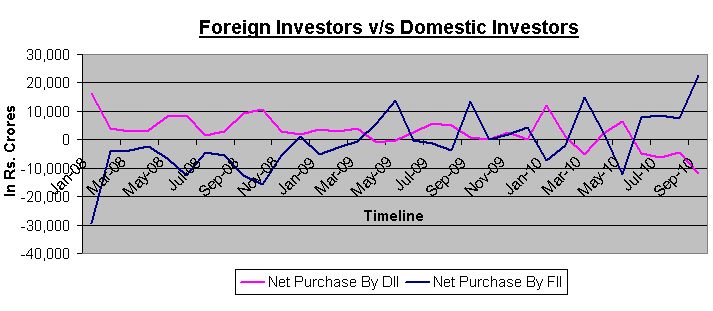
The first question, then, is to ask who paid for this ride? FIIs have put in record amounts of money in the stock market this year. The above chart I have assembled shows how currently FII have been strong resilient net buyers and domestic investors are selling their investments. The domestic investors are probably not confident of the market so much and definitely when the Sensex is in the 18,500+ range.

Indian markets are a good bet for foreign investors for whom the lack of good investment opportunities in the West is making them look East. There are still some worries about the debt-laden Euro nations. The recovery in America has been very pale as the Fed prepares for another round of Quantitative Easing. Gold a negative barometer of economic expectations has been touching all time highs in recent weeks.

This leads to my second question, so how long will the Sensex hover above the 20,000 level? Well there is a slight idea that it could be as long as the foreign investors want to stay put in the Indian markets, which implies as long as no other attractive investment opportunities emerge elsewhere outside India. But it leaves us thinking that would the FII continue the bull rally in coming months and achieve record heights, or simply book profits and correct.

Again all this depends on the markets perception of the fundamentals of the stocks. India’s P/E ratios remain higher compared to the P/E ratios across the rest of the world. While some analysts have said that the coming quarterly results might be rather dull, others are expecting a stable market till Diwali followed by a market correction.
Source: Stockezy.com
Coming to the last and most important question that is this the right time to invest in the markets? If you were till now expecting a clear answer from me, I am sorry to disappoint you. I am still not convinced about the reasons to be bullish or bearish, and I am not the only one. Well that’s also what the market has been thinking in the last couple of weeks. Have look at the NSE VIX, which measures on the basis of existing options contracts, the market’s expectations in the coming days or months. High volatility in recent weeks shows how investors are currently viewing the market’s situation.

To sum it up, the market can be judged to thriving on exuberance and optimism, whether it is rational or irrational, only time will tell. I think it will be prudent and wise for me to sit out of this fight and leave it for the biggies to clean up. Will you too?

Friday, November 5, 2010

Privacy Policy

Privacy Policy for finance-made-easy.blogspot.com/

If you require any more information or have any questions about our privacy policy, please feel free to contact us by email at jokoteles@gmail.com.

At finance-made-easy.blogspot.com/, the privacy of our visitors is of extreme importance to us. This privacy policy document outlines the types of personal information is received and collected by finance-made-easy.blogspot.com/ and how it is used.

Log Files
Like many other Web sites, finance-made-easy.blogspot.com/ makes use of log files. The information inside the log files includes internet protocol ( IP ) addresses, type of browser, Internet Service Provider ( ISP ), date/time stamp, referring/exit pages, and number of clicks to analyze trends, administer the site, track user’s movement around the site, and gather demographic information. IP addresses, and other such information are not linked to any information that is personally identifiable.

Cookies and Web Beacons
finance-made-easy.blogspot.com/ does use cookies to store information about visitors preferences, record user-specific information on which pages the user access or visit, customize Web page content based on visitors browser type or other information that the visitor sends via their browser.

DoubleClick DART Cookie
.:: Google, as a third party vendor, uses cookies to serve ads on finance-made-easy.blogspot.com/.
.:: Google's use of the DART cookie enables it to serve ads to users based on their visit to finance-made-easy.blogspot.com/ and other sites on the Internet.
.:: Users may opt out of the use of the DART cookie by visiting the Google ad and content network privacy policy at the following URL - http://www.google.com/privacy_ads.html

Some of our advertising partners may use cookies and web beacons on our site. Our advertising partners include ....
Google Adsense
Chitika
Amazon


These third-party ad servers or ad networks use technology to the advertisements and links that appear on finance-made-easy.blogspot.com/ send directly to your browsers. They automatically receive your IP address when this occurs. Other technologies ( such as cookies, JavaScript, or Web Beacons ) may also be used by the third-party ad networks to measure the effectiveness of their advertisements and / or to personalize the advertising content that you see.

finance-made-easy.blogspot.com/ has no access to or control over these cookies that are used by third-party advertisers.

You should consult the respective privacy policies of these third-party ad servers for more detailed information on their practices as well as for instructions about how to opt-out of certain practices. finance-made-easy.blogspot.com/'s privacy policy does not apply to, and we cannot control the activities of, such other advertisers or web sites.

If you wish to disable cookies, you may do so through your individual browser options. More detailed information about cookie management with specific web browsers can be found at the browsers' respective websites.

Wednesday, November 3, 2010

Global Capital Markets: Not There Yet

For me the current Euro crisis and the spike in gold prices reflects the investors’ inability to grasp the slow yet sweeping, rebalancing of global trade and growth. Cash surplus western investors are catching up slowly to the fact that their domestic fishing grounds are no longer viable and that their catch is falling. But, in my opinion, what they lack is knowledge and foresight to explore and enter the developing markets, where resources are abundant (and where fish are fishes). Thomas Friedman pointed out in his book ‘The World is Flat’ that the world is witnessing a globalization revolution, bringing down barriers of knowledge, information and intellect. I completely agree with his observations, but I feel finance is still not flat, although it has always been on that track.
One should now get used to increased speculation and volatility in domestic markets, as they are domestic no more; international is their new citizenship.

We are still to break down all barriers of information sharing and thus leading to an admirable state which economists call “perfect competition”. Many books have been written on the fact that globalization essentially is based on free market philosophy and has its roots in perfect competition. And so when people look at global finance, I feel they miss out on the basic assumptions of perfect completion or free markets or globalization. First, that information on prices, transactions and products are well known to all market participants.

Even George Soros, the man who made global hedge funds a symbol of global finance, questions this in his revolutionary theory of reflexivity. He also further goes on to write about how decisions of market participants have personal biases and thus enter the Keynesian animal spirits. Today there is no level playing field in global finance. From profligate and covert governments like Greece to unethical market leaders like Goldman Sachs, where is free information? With so much uncertainty the average, or better put majority, of investors will be nervous and jump on to gold.

The second assumption is that there are no transaction costs. But, in reality, today transaction costs are very high, eating into the investor’s margin. Ranging from consultancy fees, to trading fees, incoherent tax laws and legal charges; costs are higher for attracting foreign investors. Thus I reiterate that there is no level playing field.

The point I am trying to make here is that foreign investors have little (if not more) confidence and expertise while investing in developing markets. For instance, some stock analysts in India say that their foreign counterparts rely on broad macro economic data to analyze stock markets and so that explains their unpredictability when sudden macro events happen. Even I am witness to how FIIs in the last decade, even though have pumped up markets have made Indian markets even more volatile and inclined with global markets.

I feel we have a long way to go to see the full effects of a truly ‘free and flat’ global finance. One should now get used to increased speculation and volatility in domestic markets, as they are domestic no more; international is their new citizenship. Till the time we see some global regulations and standards in capital markets, like we have seen in the banking sector, investors should be worried.